

Contact us
If you are interested in cooperation, please contact us immediately, we will give you feedback as soon as possible!


Linear Rotary Actuator –ZR-DS6-20
Category:
ZR Series ( Linear Rotary Actuator )
- Product Details
- Application Cases
- Related downloads
-
1. Product Overview
The ZR-DS6-20 Linear Rotary Actuator from W-Robot is a high-performance integrated module that combines linear motion and rotary motion into one compact, servo-driven system. Designed for automation scenarios requiring precise linear displacement and continuous rotation, this actuator is ideal for applications such as assembly automation, screw tightening, component transfer, and pick-and-place systems.
2. Key Features
Dual-Axis Integration: Merges linear and rotational motion for compact, synchronized control.
High Precision: Equipped with closed-loop servo motors for outstanding accuracy and repeatability.
Compact Structure: Small footprint, ideal for limited-space applications in multi-axis robotic arms.
Strong Durability: Constructed with high-strength aluminum alloy and precision bearings for stability.
Customizable Parameters: Stroke length, torque, and speed can be customized upon request.
Low Maintenance: Designed for smooth, long-term operation with minimal servicing required.
3. Technical Specifications
Parameter Specification Model ZR-DS6-20 Motion Type Linear + Rotary Stroke 20 mm Rotation Angle 360° continuous or fixed angle (customizable) Linear Accuracy ±0.01 mm Repeatability ±0.005 mm Torque Output 0.4 – 1.0 N·m (adjustable) Drive Type Dual Servo Motor System Structure Material Aluminum Alloy + Stainless Steel Protection Level IP40–IP65 (optional) 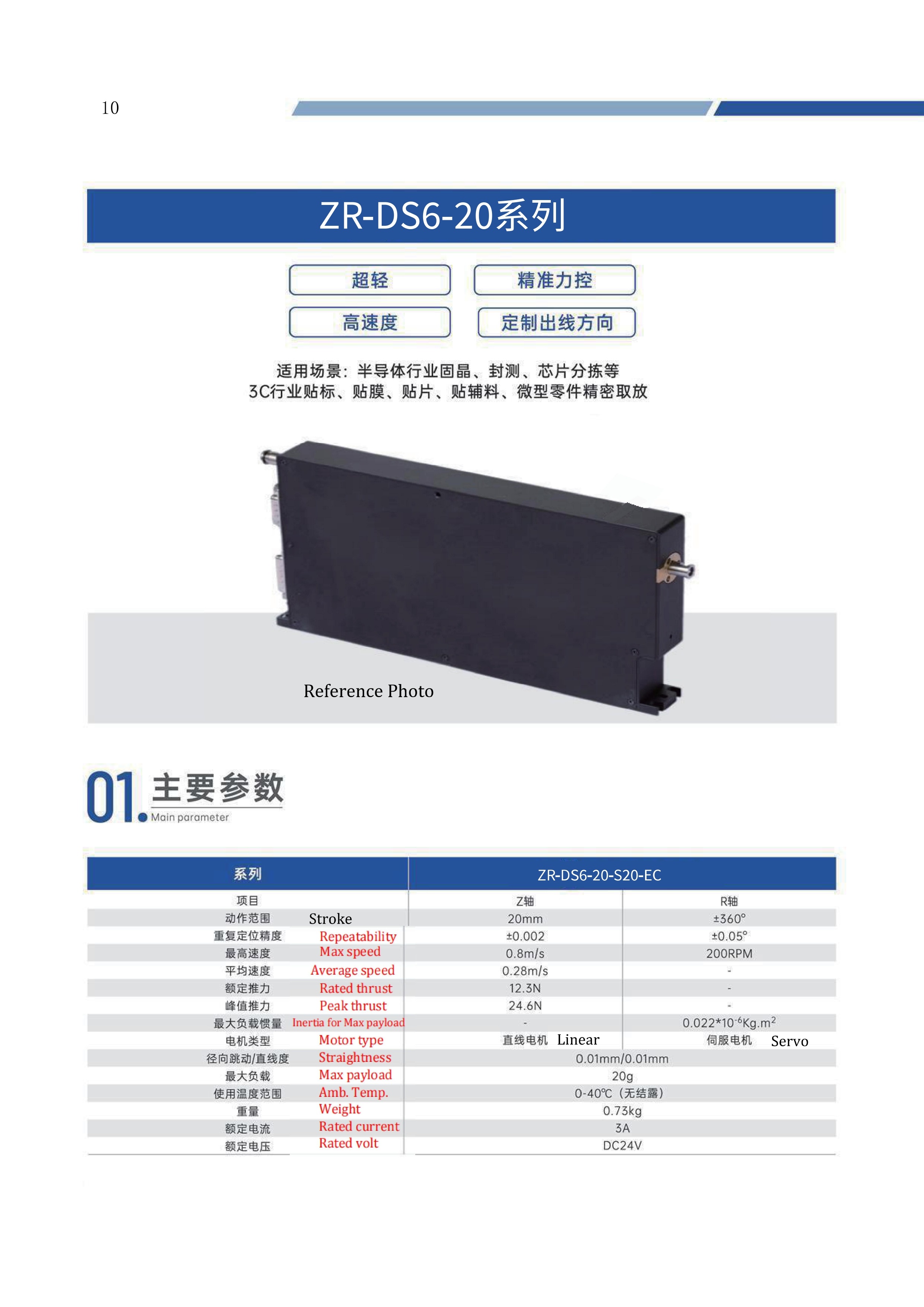
4. Working Principle
The ZR-DS6-20 integrates a dual-axis servo drive, where one motor provides precise linear motion, and the other enables smooth, continuous rotary motion. These axes operate independently or in synchronization, allowing complex movement control such as tightening, assembly, or rotational insertion tasks. The servo feedback ensures closed-loop precision, enhancing positioning accuracy and motion stability.
5. Typical Applications
Automatic screw fastening and insertion systems
Electronic and semiconductor assembly lines
Automated test and inspection stations
Component loading and positioning systems
Precision dispensing and labeling equipment
Robotic arm end-effectors for assembly or material handling
6. Advantages
Two-in-One Motion: Combines linear and rotary functions in a single compact device.
Easy Integration: Standardized interface compatible with industrial robots and motion controllers.
High Efficiency: Reduces component count and simplifies automation system design.
Cost-Effective: Minimizes wiring, installation time, and overall maintenance cost.
High Rigidity: Ensures long-term stability even under high-frequency operations.
7. Customization Options
W-Robot supports a wide range of custom configurations to match specific industry needs:
Custom stroke and rotation angle
Adjustable torque and speed levels
Interface design for special equipment
Control driver or software compatibility optimization
8. Related Products
Discover more precision motion products from W-Robot:
Factory Workshop
Listed below are answers to our most commonly asked questions. Don't see your question?Contact our customer service team. We would be glad to assist you.
FAQ
Listed below are answers to our most commonly asked questions. Don't see your question?Contact our customer service team. We would be glad to assist you.
What are the future development trends of linear modules and linear motors?
What parameters need to be provided for customized linear motors?
How long is the customization cycle of linear modules?
Can linear motors be upgraded?
Is it easy to upgrade the linear module?
What is the after-sales maintenance service of linear motors?
What is the warranty period for linear modules?
What should we pay attention to when integrating linear motors with other equipment?
Can the linear module be integrated with other equipment?
What kind of control system do linear motors require?
Related Products
Online Inquiry
NOTE: Please leave your email, our professionals will contact you ASAP!
HIGH-TECH ENTERPRISE
AUTOMATED PRODUCTION
Contact Us
> Whatsapp: +86 13360462722
> Email: [email protected]
> Address: 9th Floor, Zone C, Songhu Zhigu
Industrial Building, No. 9 Yanhe South Road, Liaobu
Town, Dongguan City
China Site: wrobot.top · Linear Module Factory & Online Quote
China Site: wrobot.top · Linear Module Factory & Online Quote
Copyright © 2025 ShenZhen W-Robot Industry Co.,Ltd. All Rights Reserved.