

Contact us
If you are interested in cooperation, please contact us immediately, we will give you feedback as soon as possible!


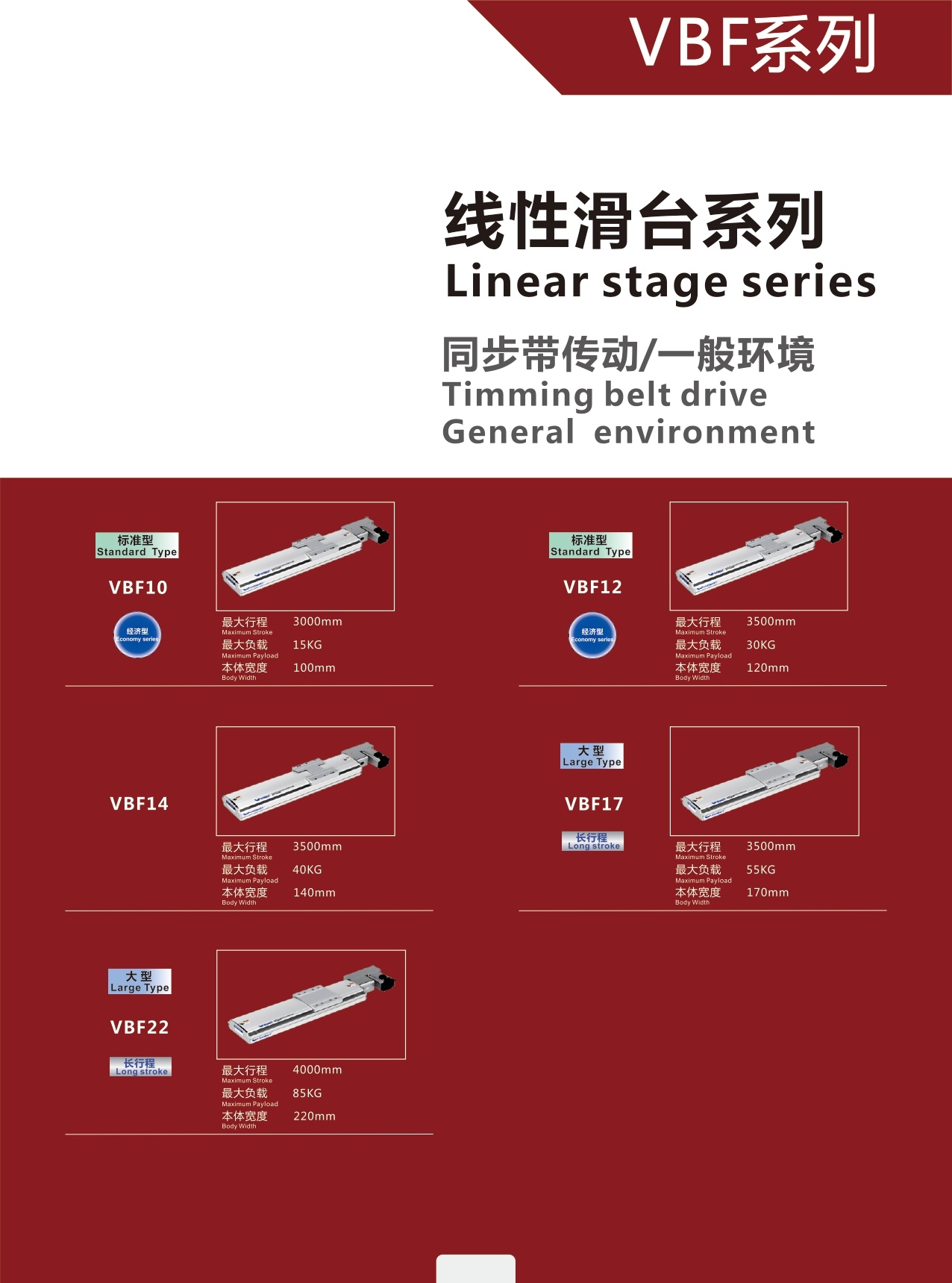
Timing Belt Modules VBF12
Category:
VBF Series (Timming Belt Linear Stage, General Environment)
- Product Details
- Application Cases
- Related downloads
-
Timing Belt Modules – VBF12
Compact Size · High Precision · Smooth and Efficient Linear Transmission
1. Product Overview
The W-Robot VBF12 Timing Belt Module is a compact, lightweight, and high-precision linear motion platform designed for automation systems that demand speed, stability, and repeatable accuracy.
Equipped with a precision timing belt transmission system, it enables fast and quiet linear movement, suitable for space-limited equipment and multi-axis integration.With its modular structure and high-strength aluminum body, the VBF12 provides reliable performance even under long operation cycles, making it a preferred choice for electronics assembly, optical inspection, and small-scale automation platforms.
2. Technical Features
High-speed timing belt drive with smooth and precise motion
Compact and lightweight design for easy integration
Low backlash and vibration, ensuring stable repeatability
Rigid aluminum structure with excellent heat dissipation
Supports both servo and stepper motors
Optional sensors and encoders for feedback control
Quiet, maintenance-free operation
Long service life under continuous duty
3. Application Fields
The VBF12 Timing Belt Module is ideal for:
Electronics and semiconductor assembly
Optical inspection and measurement platforms
Pick-and-place and small robotic systems
Laser marking and engraving devices
Automated test equipment (ATE)
Medical device production lines
Its combination of small form factor and precise motion allows engineers to achieve high-speed, low-noise automation in compact spaces.
4. Customization Options
W-Robot provides a wide range of customization options for the VBF Series:
Adjustable stroke length, speed, and payload capacity
Compatibility with all major servo driver brands
Multi-axis assembly (X/Y/Z) available upon request
Mounting interface customization for machine integration
CAD drawings (2D/3D) and full technical documentation available
5. Product Advantages
Compact and efficient linear actuator
High-speed and low-friction movement
Precision positioning with low noise
Long lifetime and low maintenance cost
Easy system integration and modular scalability
Ideal for precision automation and assembly systems
6. Installation & Maintenance
Install the module on a flat, rigid base for best accuracy
Periodically check belt tension and alignment
Keep the guide rail and belt path free from dust or debris
Avoid overloading and high humidity environments
Inspect performance every 6–12 months for optimal operation
7. Learn More
Explore more about W-Robot’s linear motion solutions:
Applications in Industrial Automation
Related Products
Electric Gripper – EPGC Series
Factory Workshop
Listed below are answers to our most commonly asked questions. Don't see your question?Contact our customer service team. We would be glad to assist you.
FAQ
Listed below are answers to our most commonly asked questions. Don't see your question?Contact our customer service team. We would be glad to assist you.
What are the future development trends of linear modules and linear motors?
What parameters need to be provided for customized linear motors?
How long is the customization cycle of linear modules?
Can linear motors be upgraded?
Is it easy to upgrade the linear module?
What is the after-sales maintenance service of linear motors?
What is the warranty period for linear modules?
What should we pay attention to when integrating linear motors with other equipment?
Can the linear module be integrated with other equipment?
What kind of control system do linear motors require?
Related Products
Online Inquiry
NOTE: Please leave your email, our professionals will contact you ASAP!
HIGH-TECH ENTERPRISE
AUTOMATED PRODUCTION
Contact Us
> Whatsapp: +86 13360462722
> Email: [email protected]
> Address: 9th Floor, Zone C, Songhu Zhigu
Industrial Building, No. 9 Yanhe South Road, Liaobu
Town, Dongguan City
China Site: wrobot.top · Linear Module Factory & Online Quote
China Site: wrobot.top · Linear Module Factory & Online Quote
Copyright © 2025 ShenZhen W-Robot Industry Co.,Ltd. All Rights Reserved.