
High Precision · Compact Design · Intelligent Linear Motion
1. Product Overview
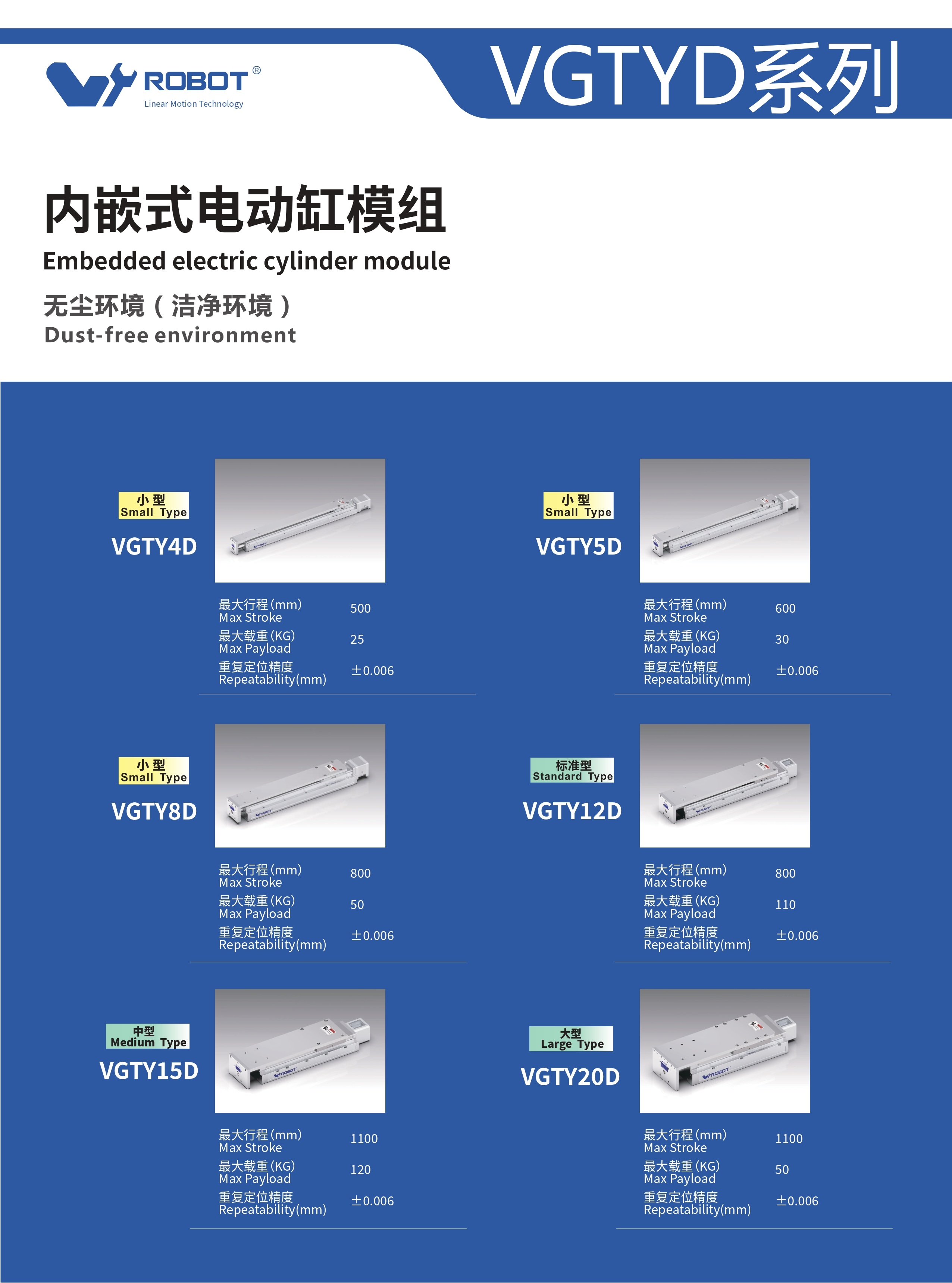
The Willbot VGTYD12 Embedded Electric Cylindrical Module is a compact high-precision actuator that integrates a motor, ball screw, and linear guide into one seamless structure. Engineered for space-saving automation, it offers stable, precise, and efficient linear motion for a wide range of industrial and laboratory applications.
With its embedded cylindrical architecture and closed mechanical design, the VGTYD12 delivers quiet operation, excellent rigidity, and long service life—making it a preferred choice for robotic end-effectors, optical inspection systems, and small-scale precision assembly.
2. Technical Features
Integrated motor + screw + guide design for compact efficiency
Cylindrical embedded housing ideal for limited installation space
Micron-level precision with minimal vibration
Stable thrust and high repeatability even under continuous load
Closed-loop control optional with built-in encoder feedback
Support for vertical or multi-axis installation
Custom stroke and speed range available
High durability and corrosion-resistant components for longevity
3. Application Fields
The VGTYD12 Electric Cylindrical Module is widely used in advanced automation and research systems, such as:
Robotic gripping and mini linear actuators
Semiconductor, PCB, and precision optical equipment
Laboratory automation and analytical instruments
Automated assembly lines and testing systems
3C product manufacturing and microelectronics production
Fine positioning and laser equipment
Its balance of small form factor and powerful output allows engineers to achieve high-precision motion control even in restricted layouts.
4. Model Selection & Customization
Willbot provides a comprehensive customization service for the VGTYD12 series:
Customizable stroke, load, and motion profile
Compatible with servo or stepper motor control systems
Available with position sensors and encoders
Multiple mounting orientations and end connectors
Multi-axis combinations (X/Y/Z) for complex automation cells
3D CAD drawings and datasheets provided for integration
This flexibility ensures seamless adaptation to diverse automation, testing, and research projects.
5. Technical Data & Support
For complete specifications, drawings, and thrust-speed curves, please contact the Willbot technical team or visit: https://www.w-robot.com/Contact.html
Our engineers provide motion analysis, controller configuration, and installation guidance, ensuring smooth integration into your automation architecture.
6. Product Advantages
Compact structure, optimized for embedded use
High precision with low backlash
Quiet, stable operation at high speed
Easy integration with PLC or robot control systems
Energy-efficient design with long service life
Minimal maintenance required
Reliable operation under continuous cycles
The VGTYD12 module achieves an ideal balance between power density, motion precision, and installation flexibility, setting a new standard for smart motion systems.
7. Installation & Maintenance
Mount on a rigid, vibration-free surface for optimal accuracy
Ensure proper alignment and preload of the screw assembly
Avoid excessive side loads during motion
Keep surrounding area clean and free of dust or oil
Check torque settings periodically
Follow manufacturer guidance for driver and parameter tuning
Listed below are answers to our most commonly asked questions. Don't see your question?Contact our customer service team. We would be glad to assist you.
FAQ
Listed below are answers to our most commonly asked questions. Don't see your question?Contact our customer service team. We would be glad to assist you.
What are the future development trends of linear modules and linear motors?
In the future, linear modules and linear motors will develop towards higher precision, higher speed, smaller size, intelligence, and integration with other advanced technologies (such as artificial intelligence and the Internet of Things).
What parameters need to be provided for customized linear motors?
It is necessary to provide detailed parameters such as load weight, stroke, speed, acceleration, accuracy requirements, installation method, and operating environment so that the manufacturer can design and manufacture a linear motor that meets the requirements.
How long is the customization cycle of linear modules?
The customization cycle depends on the complexity of the customization and the manufacturer's production capacity, generally about 1-4 weeks. The specific time can be determined by communicating with the manufacturer.
Can linear motors be upgraded?
The performance of linear motors can be improved by upgrading them with high-performance drives, optimizing control system parameters, and improving heat dissipation structures.
Is it easy to upgrade the linear module?
It is relatively easy to upgrade the motor, control system, guide rail and other components of the linear module according to actual needs to improve its performance and accuracy.
What is the after-sales maintenance service of linear motors?
Regular manufacturers usually provide comprehensive after-sales maintenance services, including fault diagnosis, maintenance guidance, parts replacement, etc., but the response speed and quality of after-sales maintenance services may vary from manufacturer to manufacturer.
What is the warranty period for linear modules?
The warranty period of linear modules from different manufacturers varies, generally around 1-2 years. The specific warranty period can be confirmed with the manufacturer at the time of purchase.
What should we pay attention to when integrating linear motors with other equipment?
Attention should be paid to issues such as interface compatibility, signal matching, control logic coordination, and installation space and layout between devices to ensure that the devices can work together.
Can the linear module be integrated with other equipment?
Absolutely. Linear modules can be integrated with other devices such as robots, sensors, and vision systems to build more complex and intelligent automated production lines.
What kind of control system do linear motors require?
Linear motors typically require a high-performance motion control system that can achieve precise position control, speed control, and thrust control, such as a dedicated linear motor drive with a motion control card or a high-end PLC.