

Contact us
If you are interested in cooperation, please contact us immediately, we will give you feedback as soon as possible!


Electric Gripper-ERGD-30-35
Category:
ERGD Series (Direct Drive Motor, Zero Clearance)
- Product Details
- Application Cases
- Related downloads
-
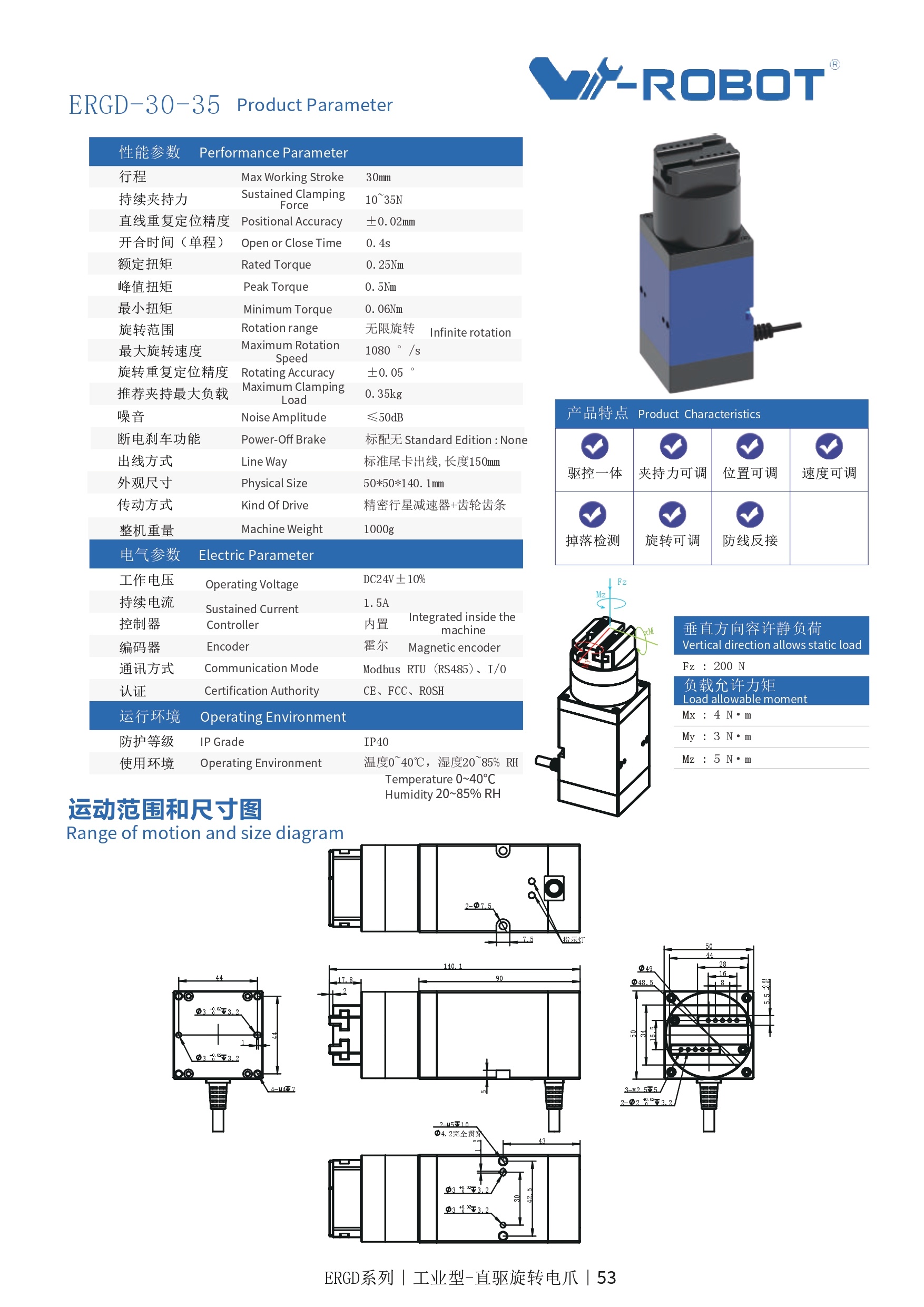
ERGD-30-35 (Rotation and Clamping, Dual Axis Servo System)
High Torque · High Precision · Integrated Rotation & Gripping Motion
1. Product Overview (Product Introduction)
The W-ROBOT ERGD-30-35 Dual-Axis Servo System is a next-generation actuator integrating rotary and gripping functions into one compact body.
This system is specifically engineered for robotic automation, precision assembly, and inspection applications, providing synchronized dual-axis motion control with high torque, high precision, and excellent dynamic response.The ERGD-30-35 enables independent or coordinated control of rotation and clamping, achieving fast, stable, and intelligent manipulation for modern automated production lines.
Its compact structure, robust servo performance, and modular integration make it ideal for collaborative robots, testing stations, and multi-axis robotic systems.2. Technical Features (Key Highlights)
Dual-axis servo structure for simultaneous rotation and gripping
High torque rotary axis with continuous 360° motion capability
Closed-loop feedback control for precise position and gripping force
Compact and lightweight design for robotic end-of-arm tooling (EOAT)
EtherCAT / Modbus / I/O communication compatibility
Low vibration and noise, ensuring smooth operation in precision tasks
Long service life with high-rigidity housing and efficient heat dissipation
Plug-and-play modular design, easy to integrate into W-ROBOT systems
3. Application Fields (Industrial Applications)
The ERGD-30-35 Dual-Axis Servo System is widely applied in:
Robotic assembly and precision clamping systems
3C electronics manufacturing and component insertion
Automated optical inspection (AOI) and alignment systems
Medical and pharmaceutical automation
Intelligent laboratory sample handling
Semiconductor device rotation and positioning modules
Multi-functional robotic grippers for collaborative robots
The integrated rotation and clamping system enables automation with higher flexibility, precision, and reliability.
4. Model Selection & Customization (Flexible Configuration Options)
W-ROBOT offers a wide range of customizable options for the ERGD series:
Adjustable rotation angle range and output torque
Multiple clamping stroke and force configurations
Interface options: EtherCAT / Modbus / CANopen
Custom mounting flanges and jaw connection types
Configurable dual-axis synchronization parameters
Optional integrated temperature and torque monitoring
Available 2D/3D CAD files and detailed technical data sheets
5. Product Advantages (Performance Benefits)
Integrated rotary and clamping functions reduce system complexity
High precision (±0.02 mm repeatability) for consistent gripping
High torque & dynamic response for rapid rotation applications
Fully enclosed design, dustproof and low-maintenance
Lightweight and modular, ideal for robot end-effectors
Compatible with multi-axis robotic configurations
Energy-efficient servo control for stable, long-term performance
6. Installation & Maintenance (Operational Guidance)
Ensure a flat and rigid mounting surface for optimal alignment
Follow recommended torque specifications for all fasteners
Keep the rotation and clamping components clean and free of debris
Regularly inspect encoder connections and servo cables
Avoid exposure to high humidity, dust, or strong magnetic fields
Perform torque and positioning calibration every six months
7. Application Cases (Practical Scenarios)
Automated optical alignment platforms
Robotic assembly of small mechanical parts
Precision inspection and tool changing systems
Dual-axis motion control in compact robotic cells
Medical automation equipment for tube handling or capping
Semiconductor testing and wafer-handling robotics
The ERGD-30-35’s high torque and precise motion synchronization make it a top choice for high-end intelligent manufacturing.
8. Learn More (Further Resources)
Explore related technical articles:
W-ROBOT: Advancing Dual-Axis Servo Control Technology in Robotics
How Integrated Rotation and Gripping Enhance Modern Automation
Learn about W-ROBOT:
Explore related products:
ERG-20-80 Dual-Axis Servo System
VGTH15 Fully Sealed Ball Screw Module
VETB22 Timing Belt Linear Module
Factory Workshop
Listed below are answers to our most commonly asked questions. Don't see your question?Contact our customer service team. We would be glad to assist you.
FAQ
Listed below are answers to our most commonly asked questions. Don't see your question?Contact our customer service team. We would be glad to assist you.
What are the future development trends of linear modules and linear motors?
What parameters need to be provided for customized linear motors?
How long is the customization cycle of linear modules?
Can linear motors be upgraded?
Is it easy to upgrade the linear module?
What is the after-sales maintenance service of linear motors?
What is the warranty period for linear modules?
What should we pay attention to when integrating linear motors with other equipment?
Can the linear module be integrated with other equipment?
What kind of control system do linear motors require?
Related Products
Online Inquiry
NOTE: Please leave your email, our professionals will contact you ASAP!
HIGH-TECH ENTERPRISE
AUTOMATED PRODUCTION
Contact Us
> Whatsapp: +86 13360462722
> Email: [email protected]
> Address: 9th Floor, Zone C, Songhu Zhigu
Industrial Building, No. 9 Yanhe South Road, Liaobu
Town, Dongguan City
China Site: wrobot.top · Linear Module Factory & Online Quote
China Site: wrobot.top · Linear Module Factory & Online Quote
Copyright © 2025 ShenZhen W-Robot Industry Co.,Ltd. All Rights Reserved.