

Contact us
If you are interested in cooperation, please contact us immediately, we will give you feedback as soon as possible!


EPGL-150-1200 Long-Stroke Electric Gripper
Category:
EPGL Series (Long Stroke, Large Clamping Force)
- Product Details
- Application Cases
- Related downloads
-
EPGL-150-1200 Long-Stroke Electric Parallel Gripper
High grip force · Long stroke · Power-off holding
1. Product Overview
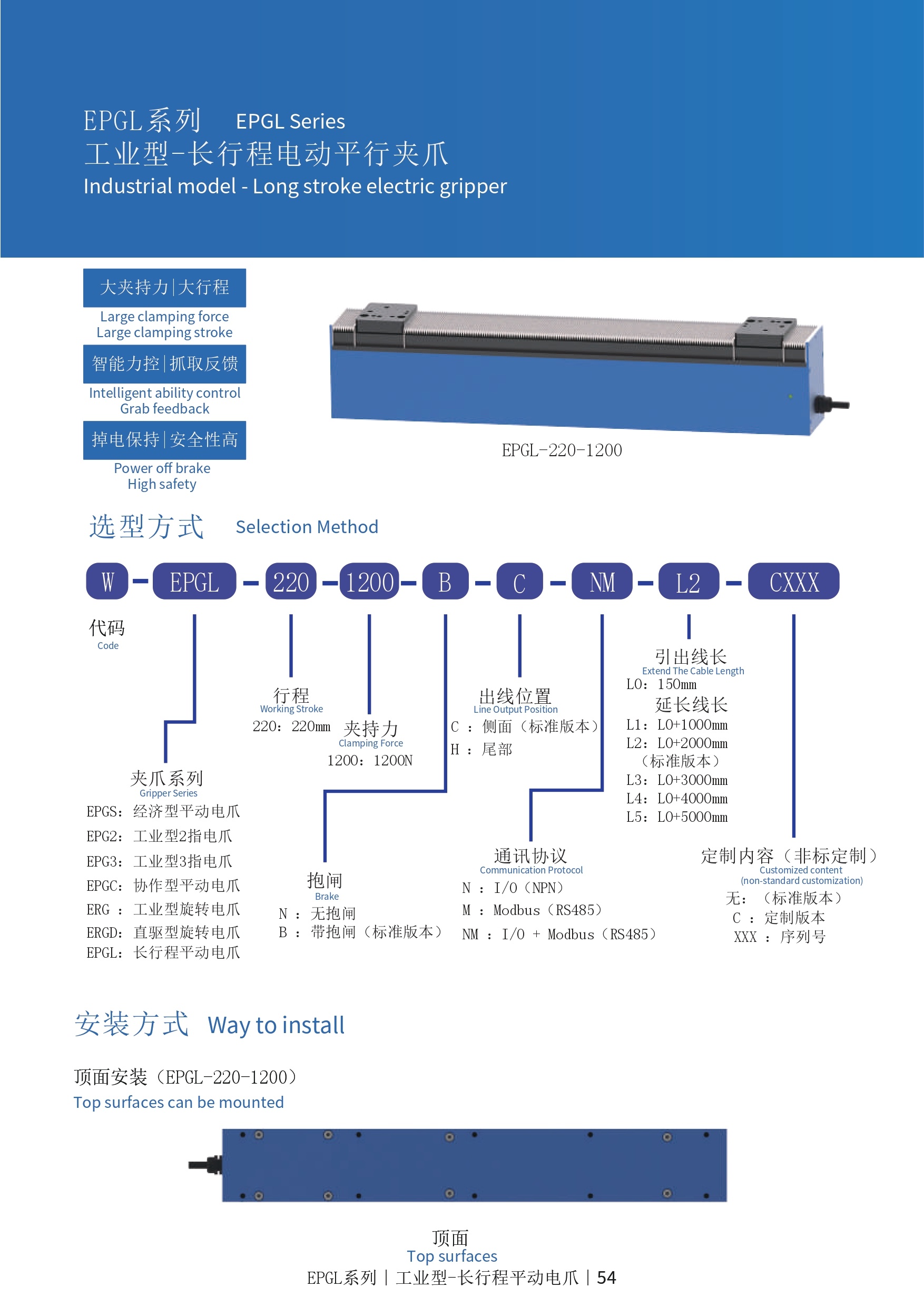
The W-ROBOT EPGL-150-1200 belongs to the EPGL series of long-stroke electric parallel grippers. It offers a 0–150 mm stroke, 360–1200 N continuous grip force and a recommended max. workpiece mass of 15 kg. The drive is a precision low-voltage servo motor with a screw and slider; the controller is built in, the supply is DC24V ±10%, communication is EtherCAT, and a power-off brake is standard, so the gripper keeps holding the part if power is lost.
2. Specifications
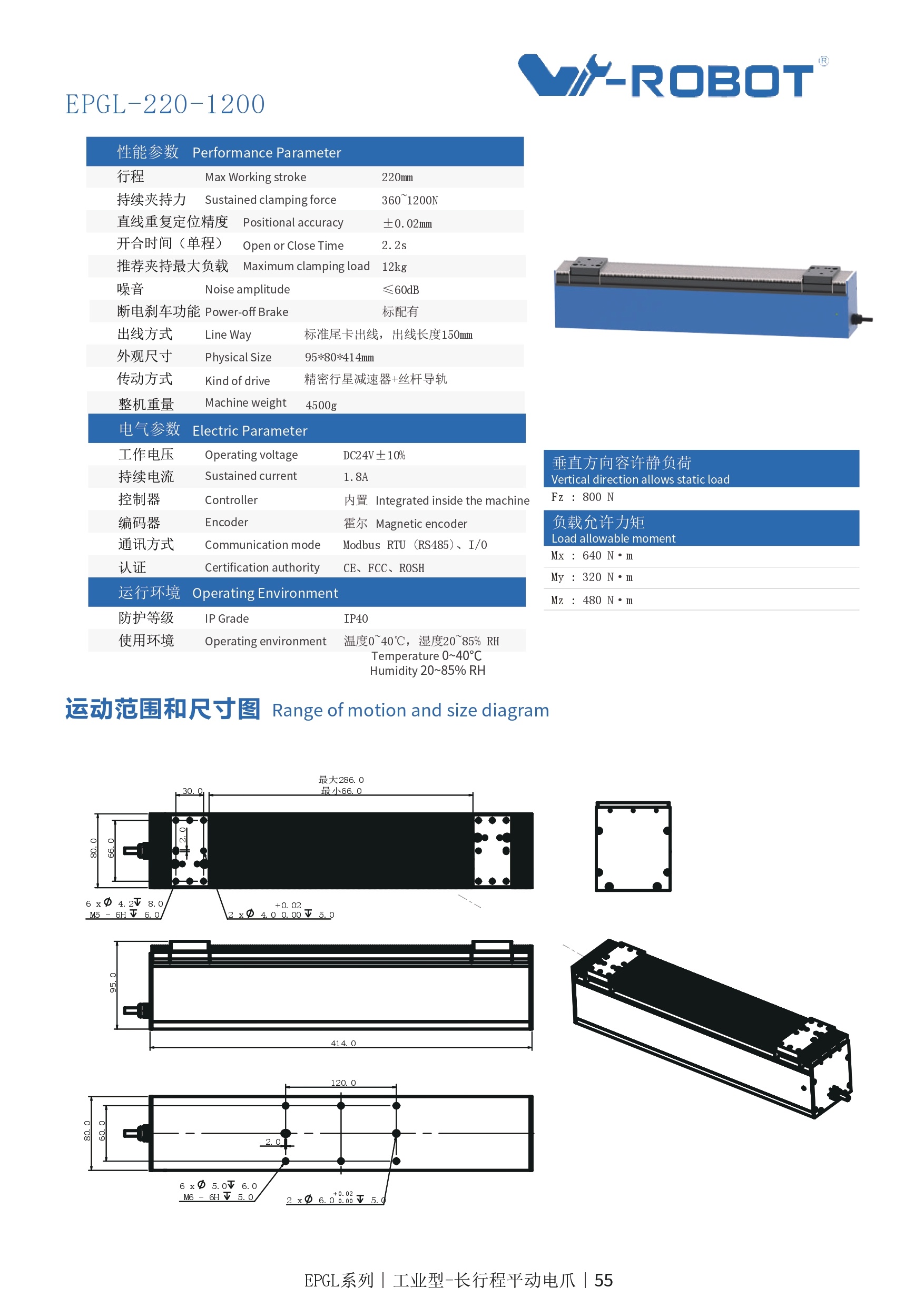
Stroke: 0–150 mm
Continuous grip force: 360–1200 N
Linear repeatability: ±0.02 mm
Open/close time (one way): 1.5 s
Recommended max. workpiece mass: 15 kg
Weight: 7200 g; dimensions: 410 × 141.5 × 70 mm
Supply: DC24V ±10%, 10 A continuous current
Controller: built-in; encoder: 17-bit multi-turn absolute
Communication: EtherCAT
Protection: IP40; noise: ≤70 dB
Power-off brake: standard
Allowable static vertical load Fz: 600 N; allowable moments Mx/My/Mz: 260 / 336 / 142 N·m
Cable: standard nut outlet, 150 mm
Specifications: W-ROBOT Electric Gripper Selection Manual (2026-08 edition). Always confirm against the latest manual or with a W-ROBOT engineer. (p.60)
3. Features
High grip force and long stroke: one gripper covers a wide range of part sizes.
Force control with grip feedback: precise force and position control with status feedback.
Power-off holding for safety: brake fitted as standard.
4. Applications
The selection manual lists new-energy power battery handling and energy storage as applications of the EPGL-150-1200. For other applications, send the part mass, size range and cycle time for an engineer to review.
5. Selection Notes
With 7.2 kg gripper mass, check the robot payload curve when mounting it on a robot, or check load, moments and acceleration when mounting it on a linear module or gantry. For the grip force and stroke method, see How to Size an Electric Gripper.
6. More Information
For drawings, 3D models or a model recommendation, contact W-ROBOT or request a quote. See the EPGL series and the electric gripper category.
Factory Workshop
Listed below are answers to our most commonly asked questions. Don't see your question?Contact our customer service team. We would be glad to assist you.
FAQ
Listed below are answers to our most commonly asked questions. Don't see your question?Contact our customer service team. We would be glad to assist you.
What are the future development trends of linear modules and linear motors?
What parameters need to be provided for customized linear motors?
How long is the customization cycle of linear modules?
Can linear motors be upgraded?
Is it easy to upgrade the linear module?
What is the after-sales maintenance service of linear motors?
What is the warranty period for linear modules?
What should we pay attention to when integrating linear motors with other equipment?
Can the linear module be integrated with other equipment?
What kind of control system do linear motors require?
Related Products
Online Inquiry
NOTE: Please leave your email, our professionals will contact you ASAP!
HIGH-TECH ENTERPRISE
AUTOMATED PRODUCTION
Contact Us
> Whatsapp: +86 13360462722
> Email: [email protected]
> Address: 9th Floor, Zone C, Songhu Zhigu
Industrial Building, No. 9 Yanhe South Road, Liaobu
Town, Dongguan City
China Site: wrobot.top · Linear Module Factory & Online Quote
China Site: wrobot.top · Linear Module Factory & Online Quote
Copyright © 2025 ShenZhen W-Robot Industry Co.,Ltd. All Rights Reserved.