

Contact us
If you are interested in cooperation, please contact us immediately, we will give you feedback as soon as possible!


Direct Drive Rotary Motor-DDRI-180-125
Category:
DDRI Series (Internal Rotor Motor)
- Product Details
- Application Cases
- Related downloads
-
DDRI-180-125 Direct Drive Rotary Motor
Ultra-High Torque · Absolute Precision · Maintenance-Free Design
Ⅰ. Product Overview
The DDRI-180-125 from W-Robot is a high-torque direct drive rotary motor engineered for precision automation, semiconductor processing, and heavy-duty robotic motion control applications.
With a 180 mm frame diameter and 125 mm body height, this model delivers significantly higher torque compared to standard rotary motors in the same size class, achieving peak torque levels exceeding 120 Nm while maintaining ultra-smooth, backlash-free rotation.Powered by a coreless stator design and high-resolution absolute encoder, the DDRI-180-125 provides micron-level angular positioning accuracy, making it ideal for demanding motion systems such as wafer handling, optical inspection, or large-axis robotic joints. Its direct-drive architecture eliminates gear wear, ensuring zero backlash, zero mechanical loss, and nearly silent operation over a long service life.
Ⅱ. Technical Features
Direct Drive Technology: No belts or gears — ensures zero mechanical backlash and high rigidity.
Ultra-High Torque Density: Continuous torque up to 40 Nm, peak torque up to 120 Nm.
High-Resolution Encoder: Supports 23-bit to 26-bit absolute encoder options for sub-arcsecond accuracy.
Low Cogging Design: Advanced electromagnetic optimization ensures smooth rotation at low speeds.
Superior Dynamic Response: Fast acceleration and braking performance for rapid indexing.
Thermally Optimized Housing: Built-in cooling channels enable stable operation in high-duty cycles.
Compact Integration: Compatible with both vertical and horizontal mount configurations.
Maintenance-Free: No lubricants or mechanical transmission components required.
Ⅲ. Application Fields
The DDRI-180-125 excels in applications where precision, torque, and stability are essential:
Semiconductor wafer processing and alignment systems
High-precision CNC rotary tables and indexing platforms
Robotic base rotation and heavy payload axis systems
Optical and laser machining equipment
Medical imaging systems and automated analysis devices
Precision metrology and calibration instruments
By delivering consistent torque and zero backlash, the DDRI-180-125 ensures perfect repeatability and accuracy, even in the most challenging environments.
Ⅳ. Model Selection & Customization
W-Robot offers modular customization options to match every unique automation requirement:
Custom torque output and moment of inertia configurations
Encoder options: Incremental, Absolute (Single / Multi-turn), or Optical / Magnetic
Hollow-shaft or solid-shaft options for cable or fluid routing
Custom flange and mounting designs
Optional integrated servo drive (EtherCAT / CANopen support)
Cooling system options (natural convection, forced air, or liquid cooling)
CAD files (2D/3D), torque curves, and full datasheets available on request
Ⅴ. Product Advantages
Zero Backlash: Delivers perfect transmission accuracy and stability.
High Torque & Compact Form: Power-dense motor for limited-space applications.
Frictionless Operation: Enables high reliability and silent motion.
High Responsiveness: Ideal for fast dynamic control and precision alignment.
Long Service Life: No mechanical wear, reducing downtime and maintenance costs.
Superior Thermal Management: Consistent performance under continuous duty.
Ⅵ. Installation & Maintenance
Ensure the mounting surface is flat and vibration-free before installation.
Apply correct torque to all mounting bolts to maintain mechanical stability.
Avoid applying side or axial loads directly on the motor shaft.
Keep all connectors clean and avoid excessive cable stress.
Periodically inspect encoder calibration (recommended every 12–18 months).
Operate within specified temperature and humidity limits for maximum performance.
The direct-drive structure requires no lubrication or mechanical maintenance, ensuring long-term reliability and precision.
Ⅶ. Learn More
Explore more with W-Robot:
Visit www.w-robot.com for datasheets, CAD files, and detailed specifications
Read: “Direct Drive Technology — Redefining Precision in Industrial Automation”
Contact W-Robot’s technical support team for integration and selection assistance
Related Products
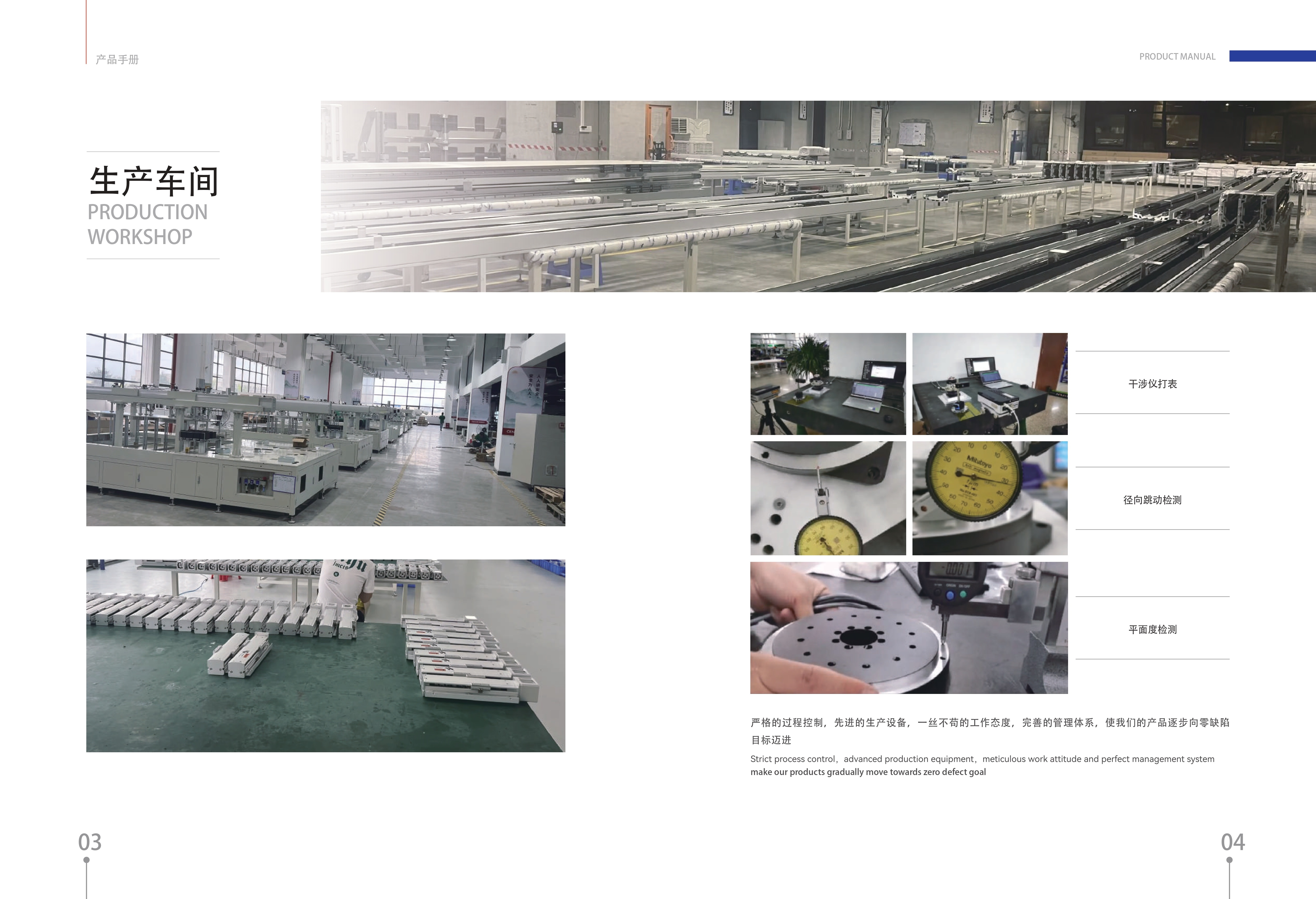
Factory Workshop
Listed below are answers to our most commonly asked questions. Don't see your question?Contact our customer service team. We would be glad to assist you.
FAQ
Listed below are answers to our most commonly asked questions. Don't see your question?Contact our customer service team. We would be glad to assist you.
What are the future development trends of linear modules and linear motors?
What parameters need to be provided for customized linear motors?
How long is the customization cycle of linear modules?
Can linear motors be upgraded?
Is it easy to upgrade the linear module?
What is the after-sales maintenance service of linear motors?
What is the warranty period for linear modules?
What should we pay attention to when integrating linear motors with other equipment?
Can the linear module be integrated with other equipment?
What kind of control system do linear motors require?
Related Products
Online Inquiry
NOTE: Please leave your email, our professionals will contact you ASAP!
HIGH-TECH ENTERPRISE
AUTOMATED PRODUCTION
Contact Us
> Whatsapp: +86 13360462722
> Email: [email protected]
> Address: 9th Floor, Zone C, Songhu Zhigu
Industrial Building, No. 9 Yanhe South Road, Liaobu
Town, Dongguan City
China Site: wrobot.top · Linear Module Factory & Online Quote
China Site: wrobot.top · Linear Module Factory & Online Quote
Copyright © 2025 ShenZhen W-Robot Industry Co.,Ltd. All Rights Reserved.