

Contact us
If you are interested in cooperation, please contact us immediately, we will give you feedback as soon as possible!


03
2026
-
11
Rotating Gripper Guide: How Electric Rotary Grippers Grip and Turn in One Unit
Author:
A rotating gripper combines a parallel gripper and a rotary axis in one electric unit, so a part can be gripped, turned and placed without a separate rotary actuator. This guide explains where that helps, how to size stroke, grip force and torque, and which W-ROBOT ERG and ERGD models fit.
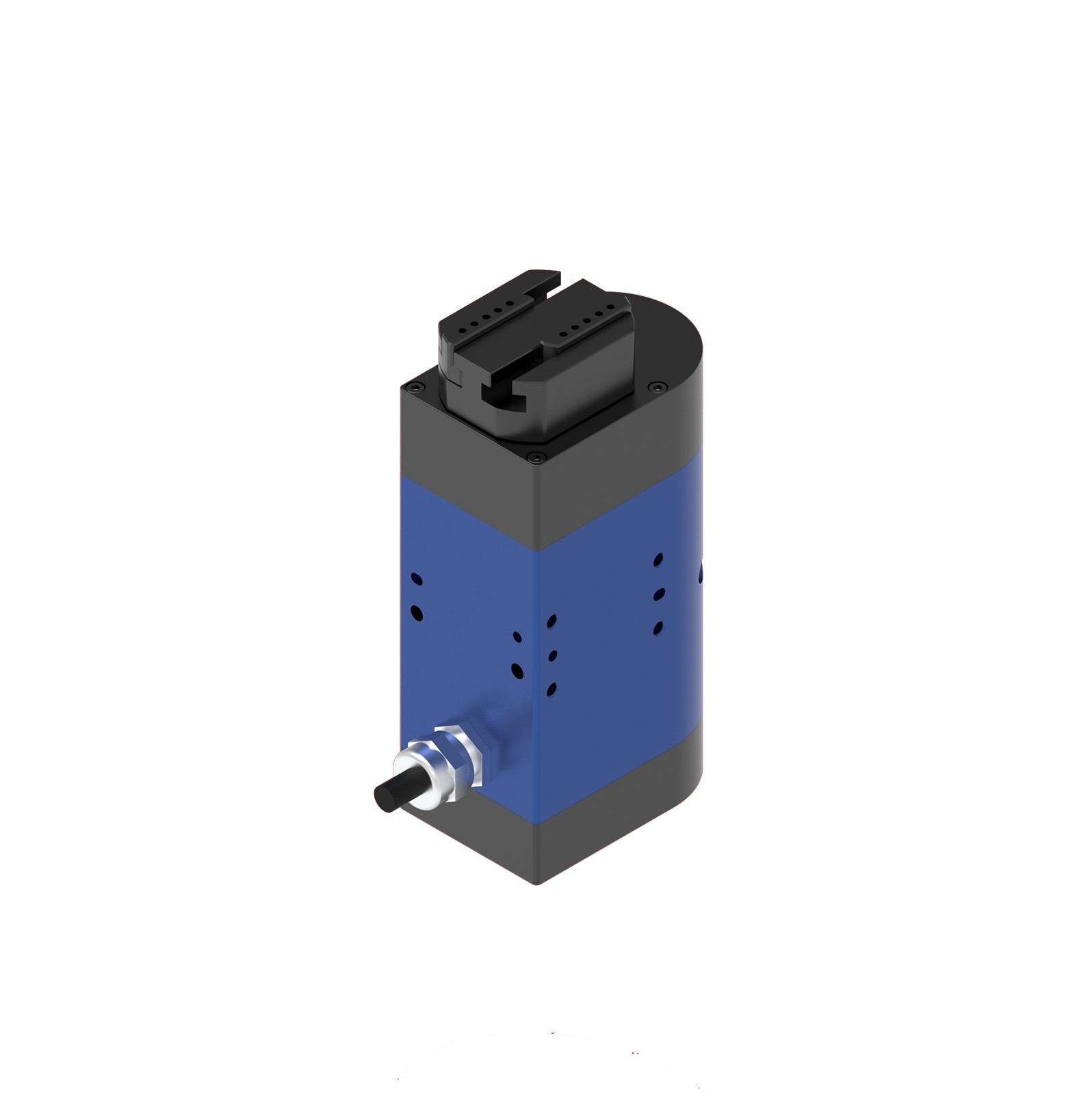
A rotating gripper (also called a rotary gripper or grip-and-rotate gripper) is a gripper with a built-in rotary axis. The fingers close on the part, and the whole jaw assembly can then turn to a programmed angle. In a classic pneumatic setup the same job needs an air gripper, a separate rotary actuator, valves, sensors and an adapter plate between them. An electric rotating gripper puts both motions, the drive and the controller into one housing.
1. When a rotating gripper makes sense
Choose a rotating gripper when the part must change orientation between pick and place, and the robot wrist or a separate rotary table is not the better place to do it. Typical cases:
- Re-orienting a part between two stations, for example turning it so a feature faces a press-fit or inspection tool.
- Angle alignment before placement, where the robot itself should keep a fixed tool orientation.
- Turning a part during handling to save a dedicated rotary station on a linear module or gantry axis.
- Tightening or screwing-type motions on light parts, after you have checked the torque against the gripper data.
If the part only needs to be opened and closed on, a standard parallel gripper is simpler. See the electric gripper range for 2-, 3- and 4-finger models.
2. W-ROBOT rotating gripper models
W-ROBOT offers two rotating gripper families: the ERG industrial rotary gripper and the ERGD direct-drive rotary gripper. All three models below rotate without an angle limit (infinite rotation), reach up to 1080°/s rotation speed, run on DC24V ±10% with a built-in controller, and communicate over Modbus RTU (RS485) and I/O.
| Model | Stroke | Continuous grip force | Open/close time (one way) | Rated / peak torque | Rotation | Weight |
|---|---|---|---|---|---|---|
| ERG-20-80 | 20 mm | 24–80 N | 0.2 s | 0.5 / 1.5 Nm | Infinite, up to 1080°/s, repeatability ±0.05° | 1000 g |
| ERG-35-100 | 35 mm | 30–100 N | Ask W-ROBOT | 0.5 / 1.5 Nm | Infinite, up to 1080°/s, repeatability ±0.05° | 1200 g |
| ERGD-25-35 | 25 mm | 10–35 N | 0.2 s | 0.25 / 0.5 Nm | Infinite, up to 1080°/s | 1000 g |
Source: W-ROBOT Electric Gripper Selection Manual (2026-08 edition), parameter pages for ERG-20-80, ERG-35-100 and ERGD-25-35. Values not listed here (for example the ERG-35-100 open/close time and the ERGD rotation accuracy) are confirmed by a W-ROBOT engineer for your project.
ERG-20-80 also lists a linear (gripping) repeatability of ±0.02 mm. The manual lists drop detection, adjustable grip force, position, speed and rotation, and reverse-wiring protection as product features of all three models.
3. How to size a rotating gripper
Step 1: stroke
Required stroke is roughly the difference between the largest and smallest gripping size plus clearance on both sides for picking and placing. With 20, 25 and 35 mm of stroke, ERG-20-80, ERGD-25-35 and ERG-35-100 cover different part-size ranges; choose the smallest stroke that still leaves clearance, because a longer move costs cycle time.
Step 2: grip force
Estimate the grip force from part mass, acceleration, friction and a safety factor, exactly as for a parallel gripper. Rotation adds tangential acceleration at the fingertips, so use the higher of your linear and rotary accelerations. The full method with a worked example is in how to size an electric gripper.
Step 3: torque
Torque is what separates rotating gripper selection from ordinary gripper selection. Add up the torque needed to accelerate the part and fingers to the target rotation speed, any friction or process torque (for example a thread that must turn), and a safety margin. Compare continuous demand with the rated torque and short peaks with the peak torque: 0.5 / 1.5 Nm for ERG, 0.25 / 0.5 Nm for ERGD-25-35. If the result is close to the rating, choose the ERG family, or ask us to check the application.
Step 4: angle accuracy and speed
If the part must land at a precise angle, check rotation repeatability. The manual lists ±0.05° for ERG-20-80 and ERG-35-100. Maximum rotation speed is 1080°/s on all three models, but in practice the move time depends on acceleration, the part inertia and settling.
Step 5: control and wiring
All three models have a built-in controller, so there is no separate drive box. Use I/O for simple preset positions or Modbus RTU (RS485) when the PLC or robot needs to set force, position, speed and angle per part. Because rotation is unlimited, plan the cable routing so the fixed housing, not the cable, takes the motion.
4. ERG or ERGD?
- Pick ERG-20-80 or ERG-35-100 when you need more grip force (up to 80 or 100 N) and more torque (1.5 Nm peak).
- Pick ERGD-25-35 for lighter parts with lower force (10–35 N) where a direct-drive rotary gripper suits the application.
- Not sure? Send the part drawing, mass, required angle and cycle time and we will recommend a model.
5. Integrating a rotating gripper with linear modules
A rotating gripper is often mounted on a Z axis of a linear module, gantry or cartesian robot. W-ROBOT builds both the gripper and the linear axes, so one supplier can check the payload, cable routing and controller interface of the whole pick-rotate-place unit. See all models on the electric gripper page, or read about our electric gripper range as a manufacturer.
Ready to size a rotating gripper? Request a quote with your part data, or contact our engineers.
FAQ
What is a rotating gripper?
A rotating gripper is a gripper with a built-in rotary axis, so it can grip a part and turn it to a set angle in one unit, without a separate rotary actuator. W-ROBOT ERG and ERGD electric rotary grippers also support infinite rotation.
How fast can W-ROBOT rotary grippers turn?
The selection manual lists a maximum rotation speed of 1080°/s for ERG-20-80, ERG-35-100 and ERGD-25-35. Actual move time also depends on acceleration, part inertia and settling.
How much torque do ERG and ERGD rotating grippers provide?
ERG-20-80 and ERG-35-100: 0.5 Nm rated and 1.5 Nm peak. ERGD-25-35: 0.25 Nm rated and 0.5 Nm peak (selection manual, 2026-08).
How are ERG and ERGD grippers controlled?
They run on DC24V ±10% with a built-in controller and support Modbus RTU (RS485) and I/O, so a PLC or robot controller can set position, force, speed and rotation.
Can a rotating gripper replace a pneumatic gripper plus rotary actuator?
In many handling tasks, yes, provided the stroke, grip force and torque match the application. Send us your part data and we will check the sizing before you change the design.
rotating gripper, rotary electric gripper, ERG, ERGD, W-ROBOT

HIGH-TECH ENTERPRISE
AUTOMATED PRODUCTION
Contact Us
> Whatsapp: +86 13360462722
> Email: [email protected]
> Address: 9th Floor, Zone C, Songhu Zhigu
Industrial Building, No. 9 Yanhe South Road, Liaobu
Town, Dongguan City
China Site: wrobot.top · Linear Module Factory & Online Quote
China Site: wrobot.top · Linear Module Factory & Online Quote
Copyright © 2025 ShenZhen W-Robot Industry Co.,Ltd. All Rights Reserved.